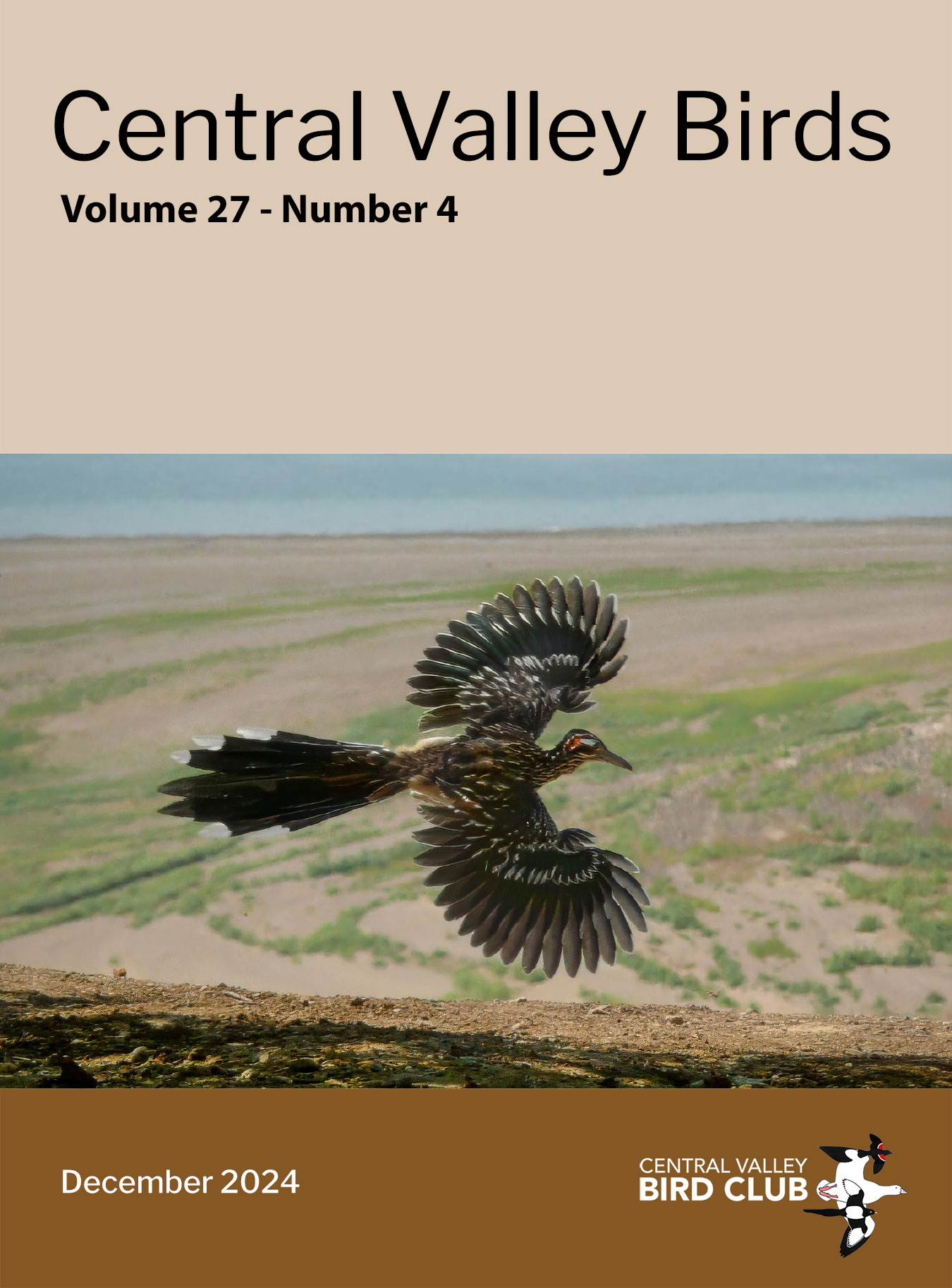
Historical and Current Status of the Greater Roadrunner in the Central Valley and Surrounding Foothills of California
DOI:
https://doi.org/10.64555/gr9sng51Keywords:
Geococcyx californianus, Central Valley, historical biological literature, early California ornithologyAbstract
The Greater Roadrunner (Geococcyx californianus) is an uncommon and sparsely distributed resident of the Central Valley and the surrounding foothills, with most observations around the edges of the valley and in the lower foothills of the Sierra Nevada and Coast Ranges. The species is most frequently encountered along the perimeter of the San Joaquin Valley. It is patchily distributed around the Sacramento Valley with most observations on the western side of the valley in the lower foothills of the Coast Range. Some researchers have suggested that the roadrunner was previously more common in this region, however, no specific sources were cited to confirm that. We attempted to determine the historical status of this species in this region from pre-European times to the present. We consulted publications about the material culture, myths, and rituals of the indigenous people of the area to gain some understanding of the status prior to and during the early days of European settlement. We reviewed specimen records, published observations of 19th and early 20th century naturalists, reports of 19th century expeditions, and accounts of early explorers and residents of the region. To assess the recent status of this species, we analyzed data from Christmas Bird Counts, Breeding Bird Surveys, Breeding Bird Atlases, and eBird. Due to the small number of detections of this species on these surveys, it was not possible to determine statistically significant trends. However, these data all suggest that the Greater Roadrunner has declined in the past few decades. Our review of historical information suggests that this species was never more than an uncommon to rare resident, patchily distributed within the region.